One of the biggest benefits of a service-based business model is its ability to guarantee a predictable revenue stream, that is little affected by short-term spending dips in the economy. In today's world of global threats from both terrorism and natural disasters, IT businesses have to free themselves from a complete reliance on a quarter-by-quarter product sales model and evolve to a service-based model. The ubiquity of the Internet has now made this truly possible.
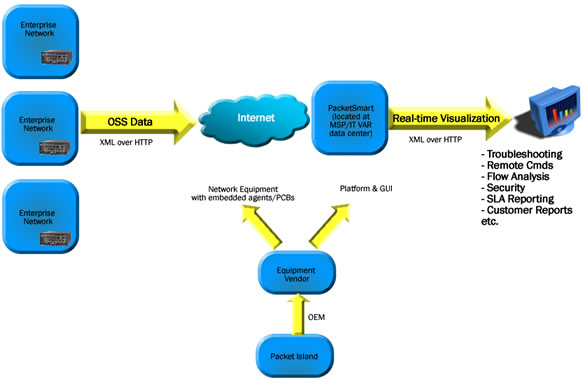
Offering a service model themselves, or enabling their customers to offer one, is an obvious next step for vendors of telecom and networking equipment. For example, vendors of IP PBXs can offer a managed service component that they can upsell to their installed base. This would involve embedding some intelligence into each PBX that ships out and deploying a back-end service management platform at their data center. Once this infrastructure is in place, the vendor can now provide a remote management service as an upsell on the support contracts they curently sell to their installed base customers. Another example is with a network router vendor who wants to provide managed network monitoring, flow analysis, or security services to its installed base. Here again, once some remote management intelligence is embedded into each network router, a service management platform can be used to remotely provide a host of value added services to its customers.
Despite the realization of the true benefits of a service-based model, most equipment vendors fail to take the next steps required to make the transition. The main reason for this is that equipment vendors lack the expertise in building highly scalable and cost effective service delivery platforms. This is where Packet Island comes to the rescue with its OEM options.