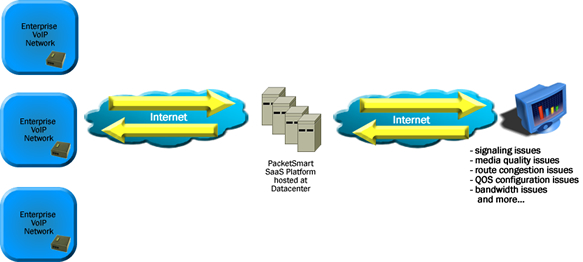
The PacketSmart solution consists of three components:
- PacketSmart Micro-appliance
- PacketSmart Software-as-a-Service (SaaS) Platform
- PacketSmart GUI
The micro-appliances are small 4"x4" devices with two (or three) RJ45 ethernet ports. Once a micro-appliance is connected in a customer's network (inline on broadband uplink, inline between two LAN segments, inline between an IP phone and the network, or on mirrored switch port) it becomes a powerful remote bulk call generator PLUS remote VoIP network sniffer for the service provider. Requiring no customer firewall re-configuration, the micro-appliances are truly plug-and-play 100bT wirespeed switching devices that, without impeding customer data traffic, can keep up with real-time analysis of VoIP call volumes experienced by most demanding SMB networks. The PacketSmart SaaS platform is a cluster of highly scalable purpose-built application servers that process, store, correlate, and analyze the large volumes of VoIP analysis data uploaded by thousands of micro-appliances for durations of weeks or months. The PacketSmart GUI is a powerful java application that allows for control of the micro-appliances and visualization of large volumes of real-time data.
The VoIP lifecycle can be viewed in terms of three major phases:
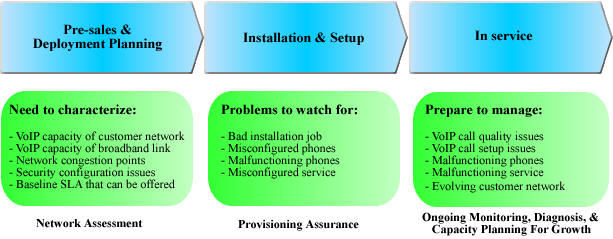
The first and probably most important phase, in VoIP lifecycle management is deployment planning. Very often vendors use the raw kbps capacity of a network to infer it's VoIP capacity. But this is a very risky approach due to the following reasons. VoIP services generate a lot more IP packets for a given amount of bandwidth, when compared to data services. Since high packet rates directly contribute to congestion, VoIP services may cause a network to degrade well before its raw kbps bandwidth capacity is reached. Furthermore, every customer network with its own natural data traffic pattern adds to the unpredictability of the results from such a simplistic estimation. Therefore the only failsafe way to estimate the true VoIP capacity of a network is to apply live VoIP traffic on it, from a variety of network points, over a long enough sample period so as to determine its maximum call capacity, its congestion points/periods, and how the business' current data traffic pattern will impact VoIP. It is not enough to apply this test just to the internal LAN because another potential point of congestion is the ISP broadband connection. Most ISPs offer some level of SLAs - however there is usually a lot of averaging built into such SLAs. Therefore, exercising the broadband link with high intensity VoIP traffic for a long enough sample period is essential in exposing congestion issues in these links.
Requiring a comprehensive network assessment before signing up a customer is the right thing to do. However, it can be very expensive to have VoIP experts travel to every customer site and setup PCs with call generators at key points in the network to perform a week long network assessment. This approach greatly increases the subscriber acquisition cost. This is where PacketSmart comes to the rescue. The PacketSmart Network Assessment solution is a Software-as-a-Service (SaaS) solution that uses plug-and-play micro-appliances to perform comprehensive network assessments at a very low cost. The simplicity and cost effectiveness of the PacketSmart network assessment solution is illustrated by the process flow show below:

The second phase in the VoIP lifecycle is the installation and setup phase. This phase typically involves a truck roll with a field technician installing and configuring IP phones in the customer network. To simplify the installation process, many vendors pre-configure IP phones before shipping them to the customer site. However, there is still the potential for problems at this point, requiring overtime from the field technician, and therefore higher setup costs, which the service provider has to absorb. Typical problems at this point involve firewall issues, malfunctioning phones, misconfigured service, etc. These problems can be solved quickly if the field technician is an expert on IP phones and VoIP technology. However, since this is not often the case, the VoIP engineers at the service provider head office spend a lot of time guiding the field technician through the troubleshooting process. If only the VoIP engineer could remotely observe and analyze the traffic from the IP phones at the customer site, this troubleshooting and service assurance process will be greatly simplified. Packet Island's solution addresses this need with the PacketSmart VoIP monitoring function. The PacketSmart micro-appliances can analyze ongoing VoIP calls (or call attempts) from the customer network enabling the VoIP expert at the head office to get real-time views on SIP/SCCP signalling data, call quality metrics, route performance metrics, traffic utilization metrics, protocol utilization metrics, and more. In this way, not only can the service provider speed up any troubleshooting process during customer deployments, but can also verify if the service has been deployed to meet their service delivery standards.
The third, and longest phase in the VoIP lifecycle is the In-Service phase. At the beginning of this phase, the VoIP service has just been turned on with all IP phones functioning smoothly making good quality calls. However, over time, the customer network tends to degrade as new devices, applications and employees are added. As such degradation happens, services like VoIP are the first to be affected. When such problems happen, the service provider needs a way to remotely analyze and characterize the problem, which includes an understanding of how the traffic has changed in that network over time. Service providers can also choose to be pro-active by performing periodic network assessments in that customer network to assist in capacity planning. The PacketSmart solution with its ability to remotely analyze and assess a customer network is essential for this phase, ensuring that the service provider can remain a partner to the customer in delivering carrier-grade services.



